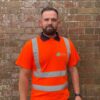
Some careers follow a path. Others build one from the ground up. At North West Recycling, Karl has spent fifteen years growing from operative to Head of Operations — and shaping the business at every step along the way.
Absolute carnage — but good carnage. I come in and do a site walk with the shift supervisor, talking through any issues, any improvements to processes. I catch up with the maintenance manager every day, check in with the team, look at production reports. You’re acting as a bridge between the two shifts — keeping communication consistent. I also discuss daily offtakes with Dean so we know what’s coming in and going out of site. Then there’s a 10am with HR, our operations Director, and the head of site maintenance. The role is really about three things: environment, safety and efficiency.
How much is going on, and how many different processes are running at any one time. People have an idea of what a recycling site looks like and it’s often completely different from the reality. There’s a huge amount of complexity behind the scenes — and a huge amount of pride in getting it right.
I learned how to manage people properly — how to have difficult conversations, how to treat people equally, how to build on your own personality rather than fight against it. I’m a friendly person by nature, and I had to work out how to turn that into a management style. People think management is about giving instructions. It’s so much more than that. The trust NWR placed in me at each step gave me the space to figure that out.
Putting the original SRF plant in. I helped build that— a lot of hours, a lot of planning, and it was genuinely new territory. We were one of the first in the region to build an SRF line. There’s something special about being part of building something from scratch and then watching it become part of how the business operates every single day.
I call it the NWR family. It started as a family business and it still feels exactly like that — even though it’s grown enormously. That hasn’t changed, and I think that’s probably one of the reasons it has grown. When you genuinely care about the people you work with, and they care about the business, something good happens. It also feels important beyond just the work — we’re taking care of the environment, which means we’re taking care of the community.
Training people is a big part of the job — ROs, MPOs, supervisors. But the best part is watching them grow. I was given opportunities to develop here, and being able to give that same opportunity to someone else, and see them go on to bigger things within the business — that means a lot. It’s how the culture stays alive as the company grows.
What we’re developing on the renewable energy side. The continuous development of the site. I love watching the business grow and being part of it growing — that hasn’t changed since my first day. When you’ve been here long enough to see what was new and exciting become standard practice, and then watch the next new thing arrive, it keeps you on your toes. The future here is genuinely exciting.
It’s grown from a small family business into something really significant — and it’s still family-run, still has that feel. That’s pretty amazing when you think about it. I’m proud to have been part of that journey, and even prouder that there’s still so much more to come.
Always give it the opportunity. The waste industry has a magnetism you wouldn’t realise — people have an idea of what it is, and it’s often so different from the reality.

Celebrating 30 years of North West Recycling 30 Years of Building From What You Left Behind This year marks a proud milestone for North West Recycling as we celebrate 30 years of service to Cumbria — and we think that strapline says it all. Because that is exactly what we do: we build something valuable […]

And How We Can Help Prevent Tragedies Refuse not refuge! As temperatures drop and winter approaches, many people experiencing homelessness face increasingly harsh and dangerous conditions. In desperate attempts to stay warm, some rough sleepers seek shelter inside refuse containers such as bins and skips. While it may feel like temporary protection from the cold, […]
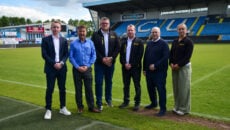
We’re proud to announce that North West Recycling (NWR) is now an official Club Partner and Waste Management Partner of Carlisle United Football Club for the upcoming season. Founded in 1995 as Brampton Skip Hire, we’ve grown over the past 30 years into the region’s largest privately owned waste management provider, serving Cumbria, South West […]
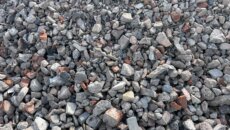
What are aggregate materials used for and what are their main benefits? Construction aggregates are often referred to as simply “aggregates,”. They are a group of materials that are used in construction to form the foundation of roads, buildings, and other structures. Indeed, there are several benefits to using construction aggregate materials in construction projects: […]
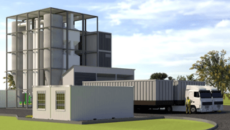
A simple guide to gasification and its benefits Gasification is a process that converts solid or liquid fuels into a gaseous fuel called “syngas”. This is done by oxidizing the fuel, creating a mixture of carbon monoxide, hydrogen and other volatile gases. The syngas produced can then be burned as a fuel in a gas […]
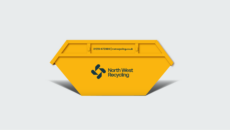
Hiring a skip is an excellent and convenient way of getting rid of waste in your home. During home and garden clean or clear outs, you will realize that you have different types of waste to dispose of. Before you embark on disposing of any waste, it is important that you understand what type of […]
Courage in business is rarely dramatic. Sometimes it simply looks like a family in Brampton choosing to do things differently. It started with a straightforward observation: the stone and soil arriving at a family farm inert landfill back in 1990 still had value. That instinct – to find opportunity in what others leave behind – […]
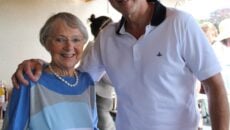
Thirty years on, the values Pam Allan brought to a kitchen table in Brampton still run through North West Recycling. Before the wagons and the processing lines, before the Rockcliffe site and the 133 -strong workforce, there was a kitchen table in Brampton and a woman answering the phone. When Rick Allan founded what was […]
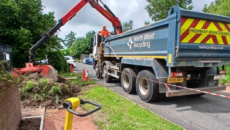
Thirty Years of Partnerships. There is a version of North West Recycling’s story that focuses on the infrastructure – the 30-acre site at Rockcliffe, the 40+ vehicle fleet, the 150,000 tonnes of waste processed every year, with 98% diverted from landfill. Those numbers matter. But they don’t fully explain how an independent family business in […]
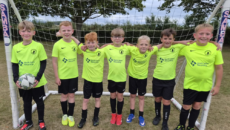
At North West Recycling, supporting our community means supporting the people in it — and that’s exactly what our sponsorship of Carlisle Reivers FC is all about. A Sponsorship Close to Home Grassroots football relies on the time, energy and commitment of volunteers, coaches and local businesses who believe in what a club can do […]
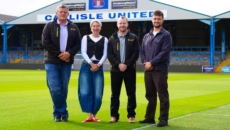
North West Recycling (NWR) is proud to confirm its official sustainability partnership with Carlisle United Football Club for the 2026/27 season. As the club’s waste management provider, NWR already plays an active role at Brunton Park – collecting and processing the ground’s food waste, glass, mixed recycling, and general waste at NWR facilities right here […]
When three local businesses come together for a good cause, the results speak for themselves. North West Recycling recently joined forces with Story Contracting and Heidelberg Materials to support a community improvement project at Eden Valley Hospice — helping create a new surfaced pathway that will make a real difference to patients, families and staff. […]
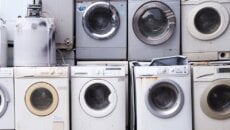
Waste Electrical and Electronic Equipment (WEEE) is a diverse and intricate category of recyclable waste that poses unique challenges in the recycling process. This category of waste consists of various electronic devices, making it a challenging waste type to handle. Our primary goal is to achieve the best possible outcome for the waste we receive, […]

 Trade accounts